Garden Enchantment
We drove east through the early morning and the traffic. As we passed by the dirt and the angels of downtown I made a mental visit to the Avila Adobe and remembered it’s about time that my daughter and I stopped by in person to stay a while with the spirits of this beautiful place.
I always found in myself a dread of west and a love of east
Our journey bore us further east with Steinbeck’s words ringing in my ears- would he have felt that way here, south of Salinas County in Los Angeles, I wondered- all the way until we arrived in the rarified atmosphere of the Pasadena neighbourhood which houses the Huntington Library and Gardens. An excursion to this estate which comprises botanical gardens, a historical library and an art collection has been on my list ever since I learnt of its Japanese Garden. The visit proved to be a wonderful way to experience one of the dimensions of Los Angeles you can easily miss out on as a local, if you don’t consciously make time for it.
As soon as we stepped outside the car, we heard the birdsong and felt the quiet resting in the air. It’s true what they say; you really don’t feel you are in LA here. The Huntington Library and Gardens, a 207 acre hilltop estate, was originally the San Marino Ranch, which was purchased in 1903 by Henry Huntington and his wife, Europhile Arabella Huntington.
Henry Huntington (1850-1927) was a Gilded Age philanthropist whose money came from the railroads. He is a fascinating character; his influence on the early development of Los Angeles enormous. My initial research into him has thrown up all sorts of avenues of enquiry which, once pursued, will clarify my understanding of this crazy place we call home. Who knew for example, that Los Angeles once had a flourishing street car system, the red and yellow cars in popular parlance, and that Huntington was one of the tycoons responsible for them? I had no idea that our former home down the road Huntington Beach was initially named Pacific City and then renamed in his honour after he agreed to extend his Pacific Electric ‘Red Car’ railway out to it in 1904.
Looking at the state of our public transit system today one might very well tear one’s hair and entreat the local spirits to pull back the curtain of the past so that we could see just what happened. Something certainly did, but it’s a mystery to be solved on another day. Perhaps when we return to the noir underbelly of our City of Angels.
Henry and Arabella transformed a working citrus and grain ranch into their own personal haven with beautiful themed gardens, each containing staggering variety of plants and flowers. In part, the outdoor elements of the estate helped Arabella, a lady used to luxury of an old world texture and therefore no fan of Southern California, to feel at home during her somewhat brief annual visits to the estate. The Rose Garden with its Tea Room, the English Herb Garden and The Lily Ponds, which were influenced by Monet’s Giverny, were all designed to bring happiness and comfort to her - and in the case of the Rose Garden, provide cut flowers for the mansion.
The Huntingtons also housed their growing art and book collections on their estate. Over the years, as the scale and value of their collections, particularly of rare manuscripts became apparent, Henry began to focus on the preservation of their collection in perpetuity. For this reason, work on the Huntington Library began in 1919 and the building opened its doors to the public in 1928, one year after his death.
As we were walking around the grounds, which are welcoming and warm with enchantment from the beginning, I mused about the difference between this estate and those other megaliths of Los Angeles, The Getty Museum and Villa, and the effect that, even now, the personalities of their respective founders seem to exert upon their atmospheres. While Henry Huntington seems to have been a civically minded and well-liked individual, no one could accuse Jean Paul Getty Sr. of being a generous man.
My daughter and I enjoyed a wonderful few hours. Beginning with our meander past the Shakespeare Garden where we paid homage to sweet William, we then stopped a while across from the Huntington mansion in the North Vista Garden. This is a long green lawn, about the size of two football fields which contains a wonderful array of Italian sculptures; Arabella’s morning view as she descended her grandly curving staircase. I stood beside the beautiful rendering of Orpheus and Eurydice by Lorenzo Mattielli (1687-1748) and heard the breezes whisper:
iamque vale: feror ingenti circumdata nocte
invalidasque tibi tendens, heu non tua, palmasAnd now farewell: I am carried away enveloped in deepest night
Stretching out to you, alas, hands that are no longer yours (Virgil, Georgics IV)
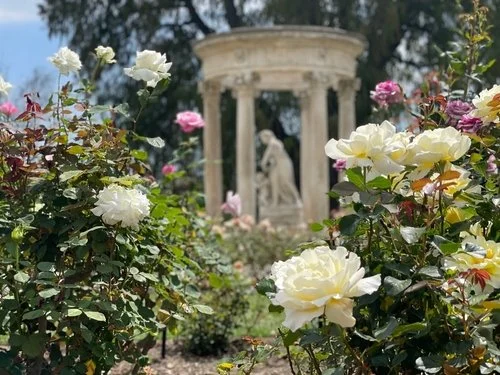
It was but a hop skip and a jump to The Rose Garden and The Temple of Love. As my daughter photographed away I was lost in thought - mesmerized by the beauty of it all and the sheer variety of named roses. There are over 1,400 cultivars here; we met Passionate Kisses, and Perfume Breezes among many others. With my penchant for dark roses I’m now keen to meet Twilight Zone, Ebb Tide and Mr Lincoln.
We travelled on and came to the garden I have wanted to see above all others and it didn’t disappoint. The Japanese Garden begun in 1908, is built into the side of a ravine and perfectly designed and executed. With trickling waters, its iconic moon bridge-the original center piece of the nine acre garden-and so many shades of green you could bathe in them, we could have stayed for hours more. We reached the top of the winding path and rested in the Zen Court and then marveled at the sheer number and variety of trees, immaculate in miniature, in the Bonsai Court. I was amazed to discover later that the Japanese style building in the garden is actually a 320 year old family home, donated by the Yokoi family and moved over 6,000 miles from Marugame to Los Angeles. It was opened to the public in 2023.
A similarly recent addition to the Huntington is the Chinese Garden (Liu Fang Yuan or the Garden of Flowing Fragrances) This was my daughter’s favourite and in fact stole my heart too. Centering around a lake, it is simply stunning and deeply moving in the tranquility it generously holds. We have only begun to scratch the surface of all that this garden offers- you can read more about it here but knowing such a space exists, crafted with exquisite care and still to be thoroughly explored, makes several return visits a pleasure to be looked forward to.
We took lunch and then moved to the Huntington Gallery, originally the Beaux Arts mansion which the Huntingtons called one of their homes. Nowadays the extensive collection of European art which they amassed resides within its walls. Arabella, at the time of her death in 1924, was said to be one of America’s richest women and also one of the world’s foremost European art collectors. Our initial tour of the Gallery on this visit revealed a wonderful curated and varied collection which will be an excellent resource for our daughter’s art history education.
As we made our way home later, I mused over the movement of artworks during this period and found myself back in WW1 territory, confronting the reality of the transfer of money, power and assets from Europe to the United States that occurred in the aftermath of this disaster. A particularly poignant resonance, as the Huntingtons are known to have acquired much of their collection at this time through art dealers such as Sir Joseph Duveen whose attitudes were later famously embodied in the sentiment: ‘Europe has a great deal of art, and America has a great deal of money’. Of course we can remember that the Huntingtons put their private collection to good use when they transformed it into a public trust in 1919 but still… sic transit gloria mundi.
There was much we didn’t see during our first visit, which was exactly as I had planned. An initial exploration to be followed by many more visits during which we can become properly acquainted with each of the wonderful gardens and then venture inside the gallery to stand in silent communion with the lonely cultural relics of a once glorious, fading world.
Image with this piece is of the Temple of Love in The Garden of Roses.
You can see more images of the Huntington Library and Gardens here