Fender Bender Poets: Part 1
Join me in my nightmare! The second in The Nightmare Series is here and we’re in the terrifying world of Edgar Allan Poe. For this week’s post, I would have the text of The Raven to hand and for full immersion I would listen to the amazing Christopher Walken recite the poem in its entirety!
***********************************************
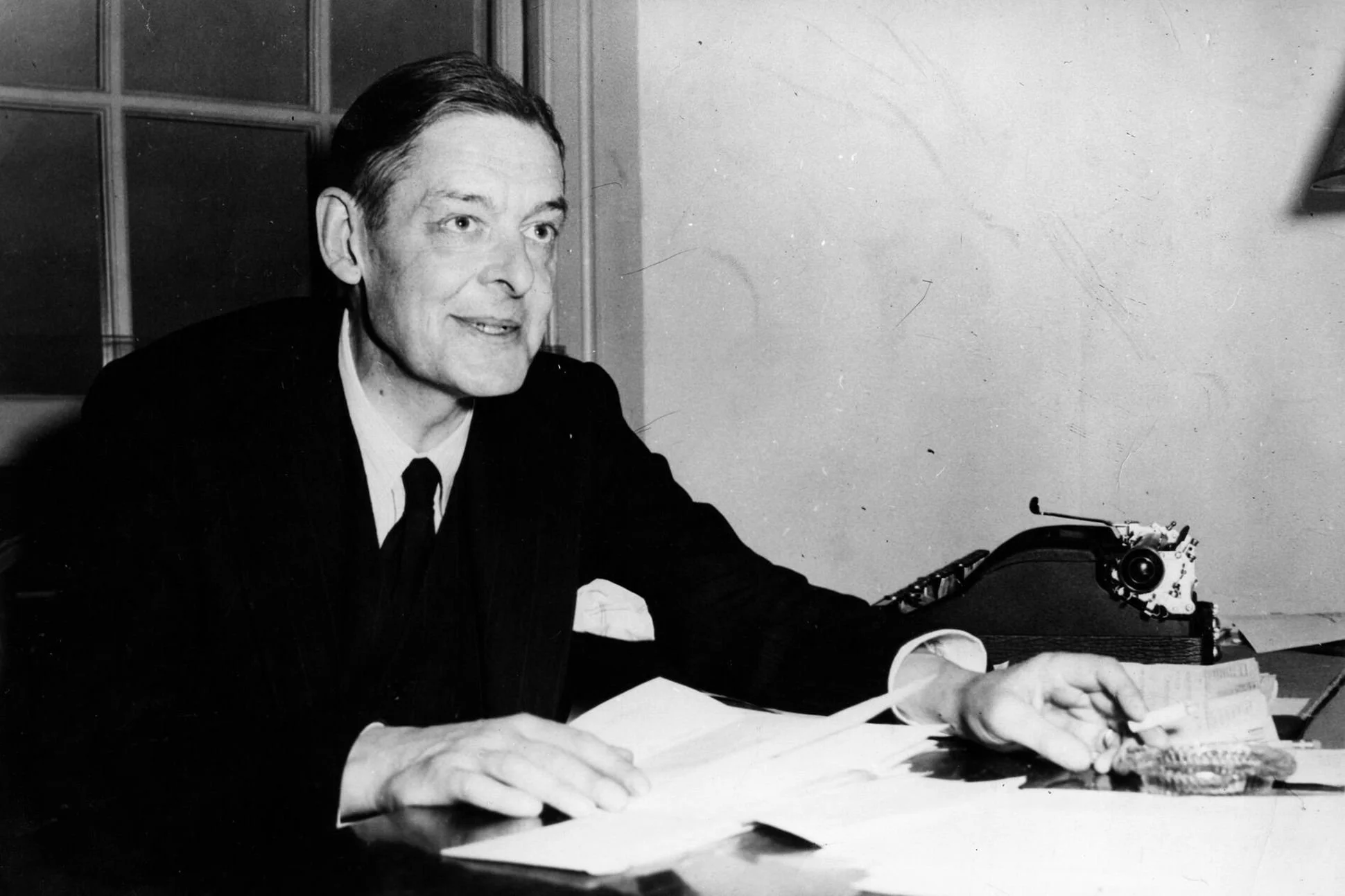
Poe had, to an exceptional degree, the feeling for the incantatory element in poetry, of that which may, in the most literal sense, be called ‘the magic of verse’ (T.S. Eliot: From Poe to Valery)
I read the poetry books mostly, Byron and Shelley and Longfellow and Poe. I memorized Poe’s poem “The Bells” and strummed it to a melody on my guitar (Bob Dylan Chronicles Vol.I)
I arrived in the land of the ‘master of the macabre’ quite by chance and without any roadmap whatsoever. Now that I’m here, I’ve found it impossible not to unpack and stay a while. I see Poe’s influence everywhere: in art, story, film and songs that are as familiar to me as the back of my own hand. This post is the first of several on this towering figure. With apologies to the experts.
Edgar Allan Poe’s life was tragically short and filled with loss. Born in Boston on January 19, 1809 to actor parents, he was orphaned at the age of three, when his mother died from consumption. Separated from his siblings, he was brought up but never formally adopted by John Allan, with whom he had a difficult relationship which ended in bitter acrimony. Poe’s wife Virginia died in 1847 aged 24 after a long and lingering struggle with consumption and he himself was found dying in a Baltimore gutter aged 40 in mysterious circumstances.
Most famous perhaps for his macabre and terrifying short stories, think of The Tell-Tale Heart, The House of Usher and Masque of the Red Death to begin within, Mr Poe also invented the entire genre of detective fiction with C. Auguste Dupin of The Murders in the Rue Morgue; don’t go putting on any airs now! As Chandler said, ‘It all began with Poe - The Murders in the Rue Morgue’. Poe was also a stringent literary critic and magazine editor as well as a poet. His poetry speaks of a profound acquaintance with beauty, grief, loss and the impossibility of the passing of time.
For the moment it is this poetry which concerns me. My first stop in Poe’s territory was The Raven and so there we shall begin. From the elementary school classroom to serious study, it was the sheer musicality of this poem which caught my attention immediately. I was not at all surprised to read of its instant and dizzying success upon publication in the New York Evening Mirror on January 29, 1845.
The reception of The Raven might be compared to that of some uproariously successful hit song today. “Everybody reads The Raven and praises it,” said the New World, two weeks after its appearance, “justly we think, for it seems to us full of originality and power.”…the New World [also] called it “wild and shivery” written in “a Stanza unknown before to gods, men and booksellers. (Edgar A Poe, A Biography, Kenneth Silverman)
The Raven, a first person narrative poem of eighteen stanzas, tells the story of a scholar, thought by some to be Poe himself, who seeks escape from his overwhelming grief at the loss of his beloved, Lenore. One cold December night he is studying in isolation when he begins to hear an inexplicable tapping at his door. Eventually he discovers a raven at the window who enters his room and refuses to leave. The scholar addresses a series of increasingly desperate questions to this mysterious bird who, endowed with the power of speech, utters only one word repeatedly, which becomes the poem’s choral refrain ‘Nevermore’. The scholar is slowly driven mad by the bird’s replies and by the end of the poem we realize that the bird himself is a cipher, representing the impossibility of escaping the sorrow of loss and the terrifying embrace of ensuing insanity.
It’s the ‘skipping reels of rhyme’ that are the backbone of the poem and make it so easy to memorize and such a wonderful poem to read aloud. The melodic energy, conjured by the meter and rhyme, chain us to the narrative of the poem. We are driven on through the stanzas, tapping our feet, increasingly infected with the grief and impending madness of the speaker. We are only freed from its clutches when we are left gazing, with all hope lost, at the young student’s soul trapped in the raven’s demonic shadow at the poem’s close.
The Raven is mainly written in trochaic octameter which means, simply put, that each line (excluding the final line of each stanza) usually has eight feet (or 16 syllables) which alternate between stressed and unstressed. Each line in The Raven begins with a stressed syllable. The final line of each stanza is a half line of seven syllables and this always rhymes with ‘Nevermore’. This meter works hand in glove with the rhyme scheme which contains not only line-ending rhymes, with the rather unusual scheme of ABCBBB, but also consistent internal rhyming which Poe uses to great effect to create the poem’s atmosphere. The brilliant harnessing of alliteration and assonance throughout the poem add intensity and colour the sound of the narrative in unforgettable hues.
We can look at the poem’s opening verse to see the rhyme scheme in full swing:
Once upon a midnight dreary [A] while I pondered, weak and weary [A]
Over many a quaint and curious volume of forgotten lore- [B]
While I nodded, nearly napping, [C] suddenly there came a tapping, [C]
As of some one gently rapping, [C] rapping at my chamber door. [B]
“’Tis some visitor,” I muttered, “tapping at my chamber door-[B]
Only this and nothing more.” [B]
The poem dances to the conductor’s baton immediately with internal rhyming in the first line. Then, we are hypnotized by the triple internal rhyming rushing like a river through lines three and four; we can’t help but continue, swept up with the narrator. When you recite, read or listen to the poem in its entirety you will marvel at the rhymes, particularly the internal ones. Favourites of mine lurk in stanza six, look for the word ‘lattice’, stanza 14, watch out for ‘nepenthe’ and in the final terrifying stanza 18 watch out that you’re not ‘dreaming’!
In this initial stanza, Poe also takes care to set the scene for us. Notice the grim opening, ‘Once upon’ suggestive of fairy tales is immediately drowned out by ‘midnight dreary’ then rhyming with ‘weary’. We are in the midst of the darkest part of the night, all is gloom and exhaustion. We can infer that the narrator has already suffered much even before the poem has begun. The terrifying insistence with which the raven will come to dominate his mind is indicated immediately in the rhyming of tapping and rapping and then the repetition of tapping in the penultimate line of the stanza.
Ah, distinctly I remember it was in the bleak December;
And each separate dying ember wrought its ghost upon the floor.
Eagerly I wished the morrow;—vainly I had sought to borrow
From my books surcease of sorrow—sorrow for the lost Lenore—
For the rare and radiant maiden whom the angels name Lenore—
Nameless here for evermore.
Note the beautiful assonance of line two of the second stanza which poetically envisages the ash from the dying fire as a ghostly presence and foreshadows the terrible end of the poem.
Within the inescapable repetition of his rhymes and alliteration and the rushing, addictive pace of the poem, Poe will paint a picture of the scholar utterly unable to free himself from the claws of his grief at the loss of his beloved. The first person narrative allows us to hear both his speech throughout the stanzas and bear witness to every single movement of his mind. As Baudelaire commented in La Genèse d’un Poëme, the preface to his French translation of The Raven:
C’est bien là le poëme de l’insomnie du désespoir; rien n’y manque: ni la fièvre des idées, ni la violence des couleurs, ni le raisonment maladif, ni la terreur radoteuse, ni même cette gaieté bizarre de la douleur qui la rend plus terrible.
This is indeed the poem of the insomnia of despair; nothing is missing: neither the fever of ideas, nor the violence of colours, nor sickly reasoning, nor doting terror, nor even the bizarre gaiety of pain which makes it more terrible.
Within the first two stanzas of the poem, we see the contrasting themes of light and darkness laid out before us. The setting is ‘midnight’, a ‘bleak December’ the fire is ‘dying’ and the student is drowning in ‘sorrow’ for his ‘lost’ ‘rare and radiant maiden’ named Lenore. The name Lenore, of Greek origin, itself means light or shining one.
These contrasting themes continue throughout the poem, most powerfully expressed by the dark, menacing presence of the raven himself - ‘this grim, ungainly, ghastly, gaunt and ominous bird of yore’. The ‘fowl’ with ‘fiery eyes’ who comes to represent the inescapable power of the narrator’s grief and its ability to overpower the light of reason, demonstrated with such visual power by the bird’s perch atop the head of the ‘bust of Pallas’, the goddess of wisdom, for thirteen of the poem’s verses. His ascent to such a lofty position in stanza six, contains some of my favourite lines and incidentally caused Eliot to comment drily on Poe’s preference for the sound of the word, over the sense.
Open here I flung the shutter, when, with many a flirt and flutter,
In there stepped a stately Raven of the saintly days of yore;
Not the least obeisance made he; not a minute stopped or stayed he;
But, with mien of lord or lady, perched above my chamber door—
Perched upon a bust of Pallas just above my chamber door—
Perched, and sat, and nothing more.
Just look at those internal rhymes and how brilliantly they capture the demeanor of the bird! Obeisance, stayed he and lady! Puts me in mind of another fender bender poet who internally rhymes decoys with turquoise eyes… but I digress, that’s for part two in this series.
I have spent considerable time in reading The Raven aloud and memorizing its verses. My appreciation for the skill with which Poe uses alliteration continues to grow; stanza five is one of the best place to watch a master at work.
Deep into that darkness peering, long I stood there wondering, fearing,
Doubting, dreaming dreams no mortal ever dared to dream before;
But the silence was unbroken, and the stillness gave no token,
And the only word there spoken was the whispered word, “Lenore?”
This I whispered, and an echo murmured back the word, “Lenore!”—
Merely this and nothing more.
When we recite this verse, the alliteration of d, that dramatic, plosive sound, allows us to feel the initial tormented hope and agitation of the narrator. In the midst of his isolation, he would almost rather meet the ghost of his dead lover, or some other terrifying apparition than continue in his loneliness. But then the excitement retreats along with the sounds as the plosive alliteration gives way to sibilance which slithers its hissing way through lines three to six.There is no apparition, only darkness which now seems still more sinister and untrustworthy; all that remains for the scholar is the bottomless stillness of his grief and loss, symbolised so powerfully by the fact that the only sound is the echo of his own whispering question. The claustrophobia of despair that will lead him to madness.
And the Raven, never flitting, still is sitting, still is sitting
On the pallid bust of Pallas just above my chamber door;
And his eyes have all the seeming of a demon’s that is dreaming,
And the lamp-light o’er him streaming throws his shadow on the floor;
And my soul from out that shadow that lies floating on the floor
Shall be lifted—nevermore!
In the poem’s closing stanza, after several verses where the scholar has raved, suffered visions and tried and tried again to force answers from the raven about the possibility of relief from his grief, Poe paints a silent and unforgettable scene. The bird itself remains motionless- the phrase ‘still is sitting’ is repeated within the first line- and now appears utterly malevolent- with eyes seeming like those of a dreaming demon. The narrator is imprisoned forever, his soul trapped within the raven’s shadow. His final surrender is signified by the fact that he, not the raven, utters the final ‘Nevermore’ of the poem.
Although Virginia, Poe’s wife did not die until two years after the poem’s publication, she had struggled with consumption for a five year period. It was a brutal and relentless illness which began with her vomiting blood while singing at the piano. Poe suffered each and every agony alongside her. It is possible to gain insight into his mental anguish during this period in a letter he wrote in 1846, known as ‘the horror of my soul letter’ and for this to inform our reading of The Raven with its ending which speaks silently of grief’s overpowering force and the ever-present possibility of insanity.
Six years ago, a wife, whom I loved as no man ever loved before, ruptured a blood-vessel in singing. Her life was despaired of. I took leave of her forever & underwent all the agonies of her death. She recovered partially and I again hoped. At the end of a year the vessel broke again — I went through precisely the same scene. Again in about a year afterward. Then again — again — again & even once again at varying intervals. Each time I felt all the agonies of her death — and at each accession of the disorder I loved her more dearly & clung to her life with more desperate pertinacity. But I am constitutionally sensitive — nervous in a very unusual degree. I became insane, with long intervals of horrible sanity….. I had indeed, nearly abandoned all hope of a permanent cure when I found one in the death of my wife. This I can & do endure as becomes a man — it was the horrible never-ending oscillation between hope & despair which I could not longer have endured without the total loss of reason. In the death of what was my life, then, I receive a new but — oh God! how melancholy an existence.
However, this is not to reduce the brilliance of the poem or Poe as poet. Poe himself made The Raven the subject of his famous essay The Philosophy of Composition which is a fascinating read - as are T.S Eliot’s opinions on it- and the following paragraph in particular is worth contemplating; even within the very limited scope of this initial essay of mine;
‘So never losing sight of the superlative or perfection in every point, I asked myself: Of all melancholy subjects, which is the most melancholic according to the universal intelligence of mankind? - Death, inevitable answer.- And when, I think to myself is this subject, the most melancholic of all, the most poetic? … It is when it becomes intimately allied with Beauty. Therefore the death of a beautiful woman is unquestionably the most poetic subject in the world, and it is equally beyond doubt that the mouth best chosen to develop such a theme is that of a lover deprived of his treasure.’
And now I fear I must soon take my leave, lest these meandering remarks become so long as to be unreadable. But, it didn’t take me long to start noticing. I heard the Duquesne Whistle, ‘blowing like she’s at my chamber door’. The references aren’t even hiding in plain sight. I saw The Raven in Love Minus Zero immediately, while reading the poem for the first time. The bird is different, her wing is broken, but the night is still cold and dark and Poe would, I am sure, have loved to hear the wind howling ‘like a hammer’. The raven is at Dylan’s window, coded with all of the DNA of Poe’s poem and I will never now hear the song without also hearing the echo of the poem. To close, as we opened, with one of the greatest poets and critics of them all:
But there is no easy way of proving that Poe was a great poet: the best evidence is that once his poems have become part of your experience, they are never dislodged (T.S. Eliot, “A Dream within a Dream”)
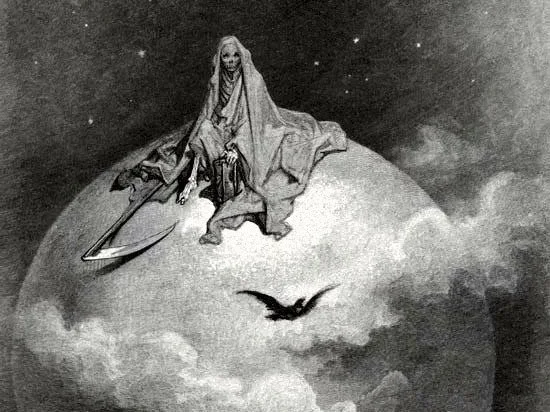
The illustration accompanying this article is from Gustave Dore’s wonderful series of illustrations for the poem. You can view the full set here